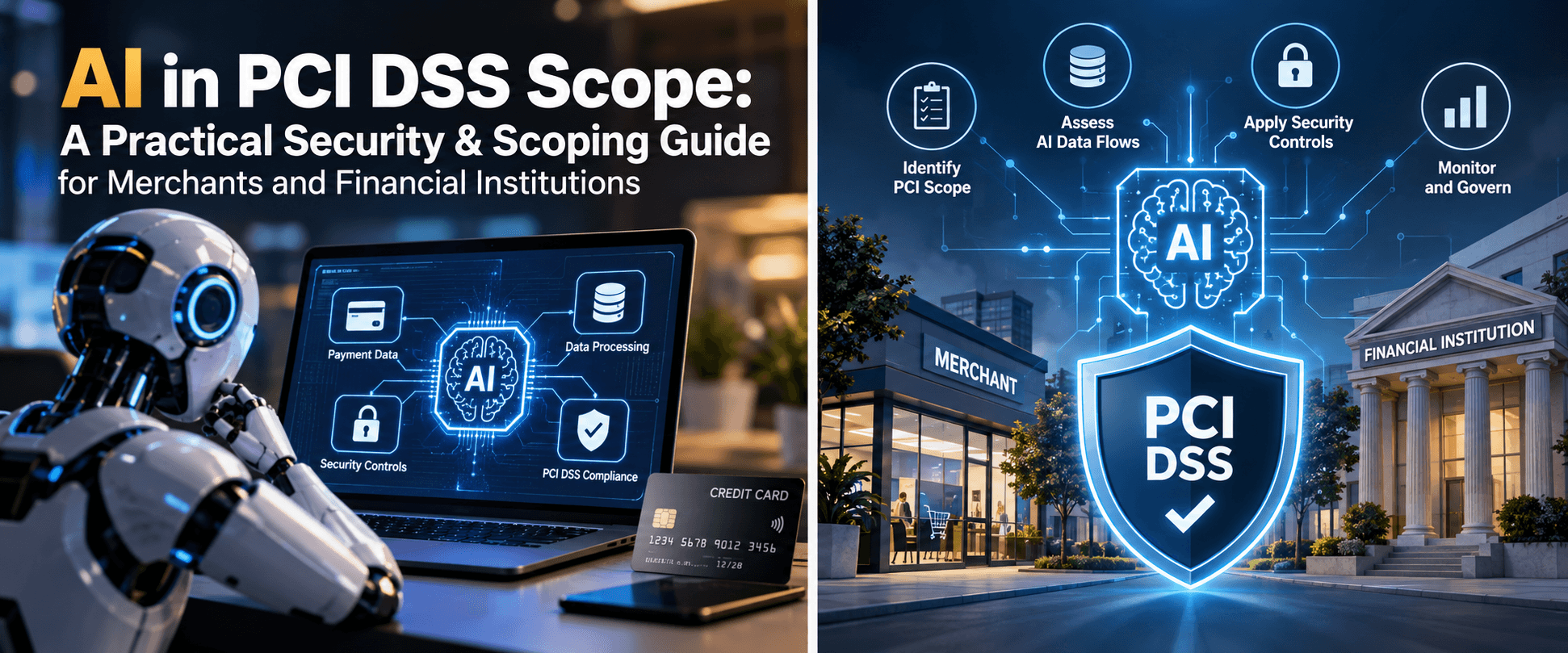
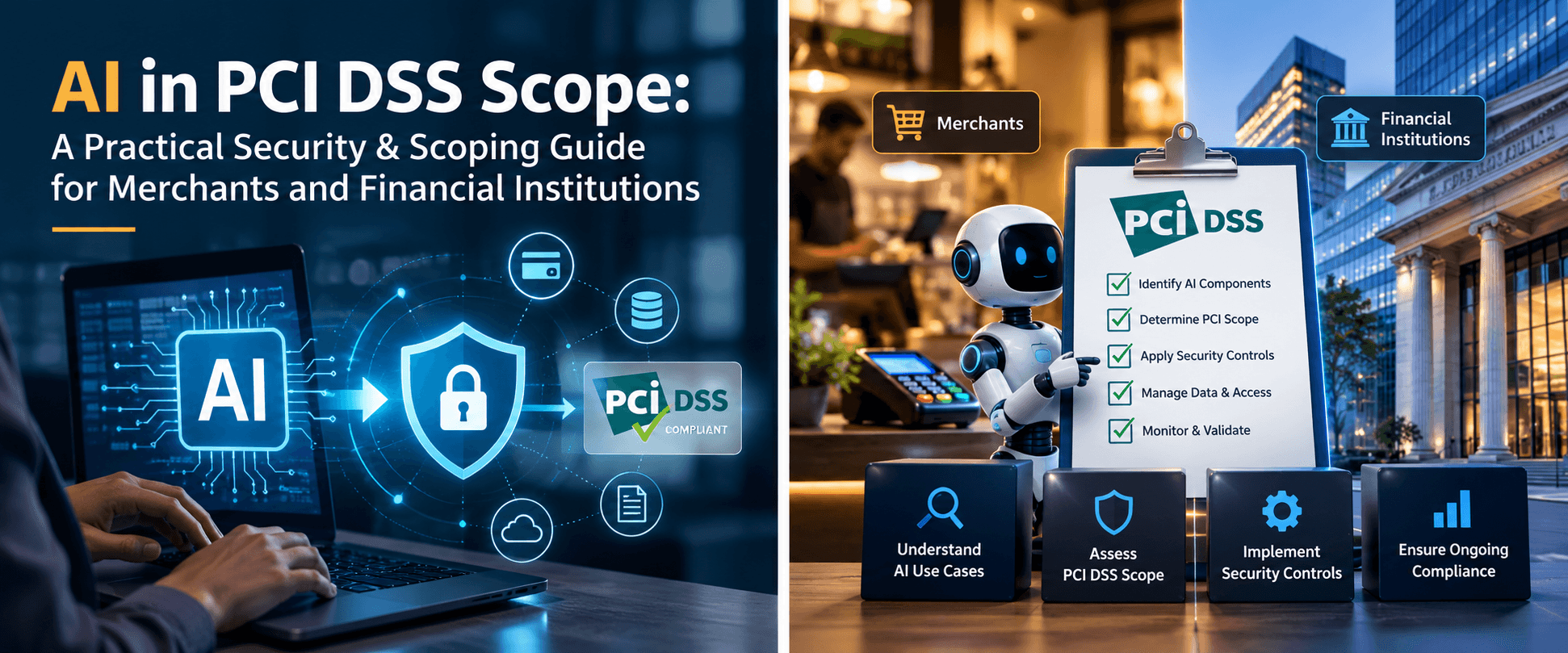
- AI systems are not exempt from PCI DSS; they must be scoped, secured, and governed like any other technology.
- Encryption does not automatically remove an AI system from scope; true isolation from decryption capabilities is required.
- To mitigate the "Lethal Trifecta," organizations must implement least agency by splitting responsibilities across multiple agents.
- AI systems must never handle cleartext secrets or high-impact credentials; they should interface with HSMs or KMS via APIs.
- Human accountability remains mandatory; "human-over-the-loop" models must be documented and assigned to a responsible individual.
Scoping AI in the Cardholder Data Environment
AI adoption in payment environments - ranging from AI-assisted coding to customer-facing chatbots - requires a rigorous scoping approach. According to the PCI SSC's Security Considerations for AI Systems (v1.0), an AI system is in scope if it stores, processes, or transmits account data, or has unrestricted connectivity to systems that do.
A critical distinction must be made regarding the "encrypted-data trap." Providing an AI system with encrypted cardholder data does not automatically remove it from scope. If the system can reach a Key Management System (KMS), Hardware Security Module (HSM), or accounts with decryption privileges, it remains in scope. Only validated isolation from the ability to decrypt removes the system from the CDE.
Mitigating the Lethal Trifecta
The PCI SSC identifies a "Lethal Trifecta" of conditions that exponentially increase risk: 1. Access to sensitive data. 2. Exposure to untrusted content (e.g., prompt injection via user inputs). 3. External communications or system access (e.g., internet connectivity, external APIs).
To counter this, organizations should apply "least agency," ensuring no single agent possesses all three elements. For example, in vulnerability management:
- A triage agent may have internet access but only read-only access to high-level config data.
- A developer agent may access source code but has no internet access.
- A deployment agent has production access but no internet connectivity.
Human Accountability and Oversight
While full human-in-the-loop review is ideal, it is often impractical against AI-speed attacks. The guidance allows for "human-over-the-loop" models where actions are monitored and confirmed. However, this does not remove human accountability. Organizations must document:
- Why a more interactive model is not feasible.
- The identity and suitability of the responsible human individual.
- Which actions are automated versus those requiring explicit approval.
- Logging, monitoring, and reversal procedures.
Managing Secrets and Credentials
AI systems are incapable of managing high-entropy secret data securely. They must never handle, generate, or manage high-impact secrets in cleartext, including cryptographic keys, passwords, or Sensitive Authentication Data (SAD) like PIN blocks.
When AI systems require credentials, the following rules apply:
- Credentials must be unique, time-bound, and device-bound.
- Management must occur through dedicated secrets management tooling.
- Credentials must never appear in source code, prompt templates, logs, or context windows.
- MFA requirements should be met using device-specific certificates, mTLS channels, or phishing-resistant credentials.
AI output should be treated as untrusted until validated. Independent Data Loss Prevention (DLP) controls must operate on egress to flag unusual output formats that could hide account data.
AI Governance and the AI-BOM
Governance must start with data classification and flow analysis. Organizations should maintain an Artificial Intelligence Bill of Materials (AI-BOM) for every approved system, covering:
- Model type, version, and harnesses.
- Accessible data and systems.
- Controls, encryption, and tokenization.
- Hosting models and maintenance responsibilities.
- Data retention policies and intended use cases.
Shadow AI - the use of unapproved public tools - is a significant compliance liability. Mitigation strategies include restricting access to known AI services, scanning endpoints for unauthorized plugins, and monitoring network traffic for Model Context Protocol usage.
Defending Against AI-Powered Threats
AI accelerates the "patch gap" by enabling attackers to discover and exploit vulnerabilities faster. Defensive priorities must shift toward:
- Continuous monitoring rather than periodic scanning.
- Rapid triage and ranking of patches.
- Computationally infeasible controls (strong segmentation, zero trust) over controls based on attack difficulty.
AI systems with console or shell access should be treated as potential malicious insiders. Furthermore, AI-generated code must be validated for vulnerabilities, outdated packages, or embedded secrets before deployment.
Keep going
Want this as a working program?
This article is a point of view. If you want to see how teams run it in practice, talk with us.
Talk to our team